

What is the Knowledge Base?
The Knowledge Base lets your voice agent access specific knowledge sources. You can upload PDFs, URLs, or text documents, and your agent automatically uses this information during conversations. This information extends your AI’s knowledge of specific topics and enables more precise, more relevant answers. While AI models have broad general knowledge, they can be enriched with up-to-date or specialized information through additional data sources. New in version 2.0: Modern toggle-based activation, real-time token monitoring, and prompt preview for voice agents.Where do I find the Knowledge Base?
1. Main navigation (left sidebar)
In the left sidebar you will find the “Knowledge Base” entry. This is where you manage all data sources centrally (upload, view, edit, delete).2. Voice Wizard - Knowledge Base tab
The Voice Wizard has a “Knowledge Base” tab where you select which data sources should be activated for your specific voice agent.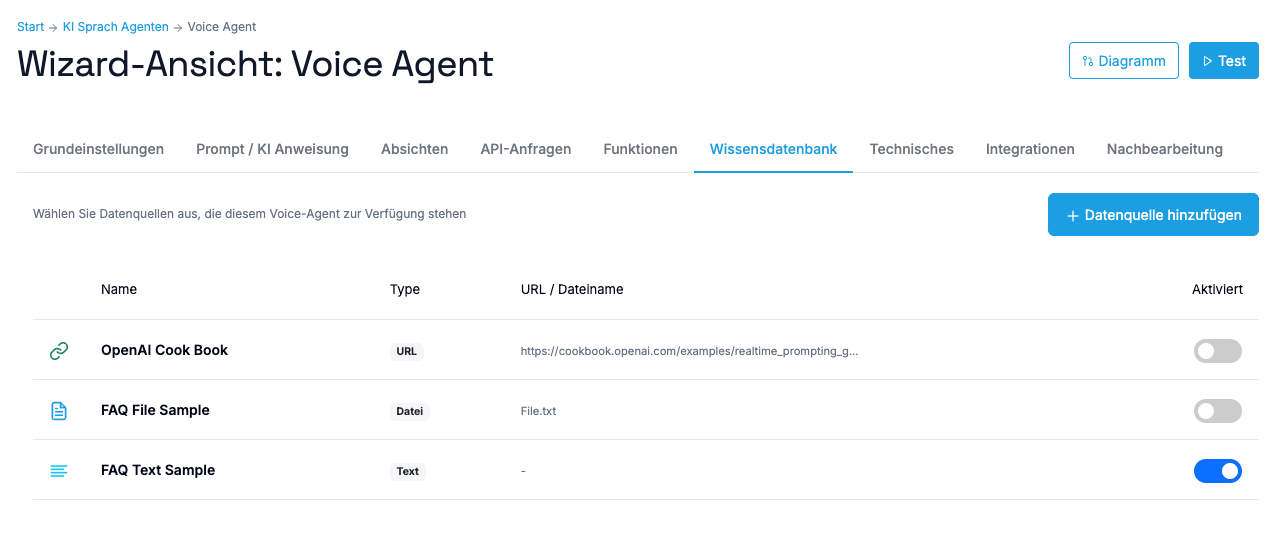
Uploading data sources
There are 3 ways to add knowledge:1. PDF/TXT file
1. PDF/TXT file
- Max. file size: 15 MB
- Max. text content: Roughly 20-30 pages of text (depending on formatting and text density)
- Important: Use high-quality PDFs with clear, extractable text. Scanned images or documents without real text cannot be processed.
2. Website (URL)
2. Website (URL)
- Automatic scraping (downloading and extracting) of the website content
- Max. text content: Roughly 20-30 pages of extracted text
3. Manual text
3. Manual text
- Direct text entry in the text field
- Max. text content: Roughly 8,000 - 12,000 words
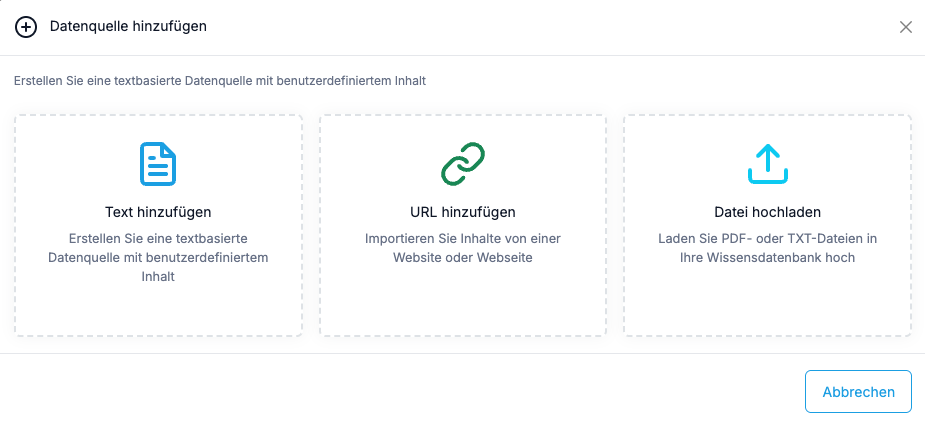
Activating data sources for voice agents
How to connect a data source to your voice agent:- Go to Voice Wizard -> Knowledge Base tab
- Find the desired data source in the list
- Enable the toggle switch next to the data source
- The context is automatically appended to the end of your main prompt, formatted as follows:
Token limits & recommendations
What are tokens? Tokens are the units in which AI models process text. One token corresponds approximately to:- ~1.5 tokens per German word
- ~1.3 tokens per English word
- Example: 6,000 German words = approx. 9,000 tokens (roughly)
Recommended limit: ~9,000 tokens
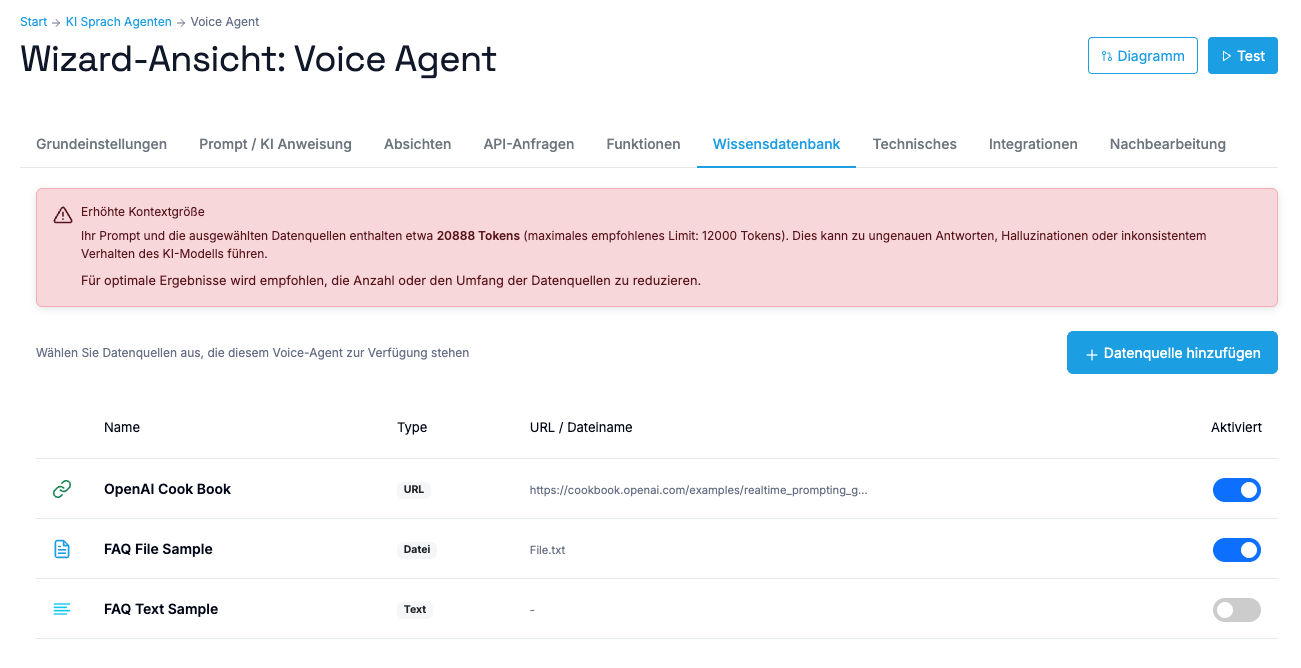
If your main prompt (the base prompt you wrote) together with all activated data sources exceeds roughly 9,000 tokens, a yellow warning appears in the Voice Wizard.Recommended upper limit: ~12,000 tokens
Above 12,000 tokens, a red warning appears. Why these limits?- With too much context, the AI may struggle to process all information correctly
- Response quality can degrade — the AI might provide inaccurate or irrelevant information
- In extreme cases the AI may start to “hallucinate” (invent false information)
- These limits are based on our experience for optimal results and precise answers
- These are recommendations, not hard technical limits
- You decide for yourself how many data sources you want to activate
- The warnings serve as a guideline for best results
- To safeguard response quality, you are prevented from uploading individual data sources that already exceed the red limit on their own
- Note: The token limits (9,000 / 12,000) are configurable if needed — contact us if you require individual adjustments
Best practices for optimal results

Prompt preview
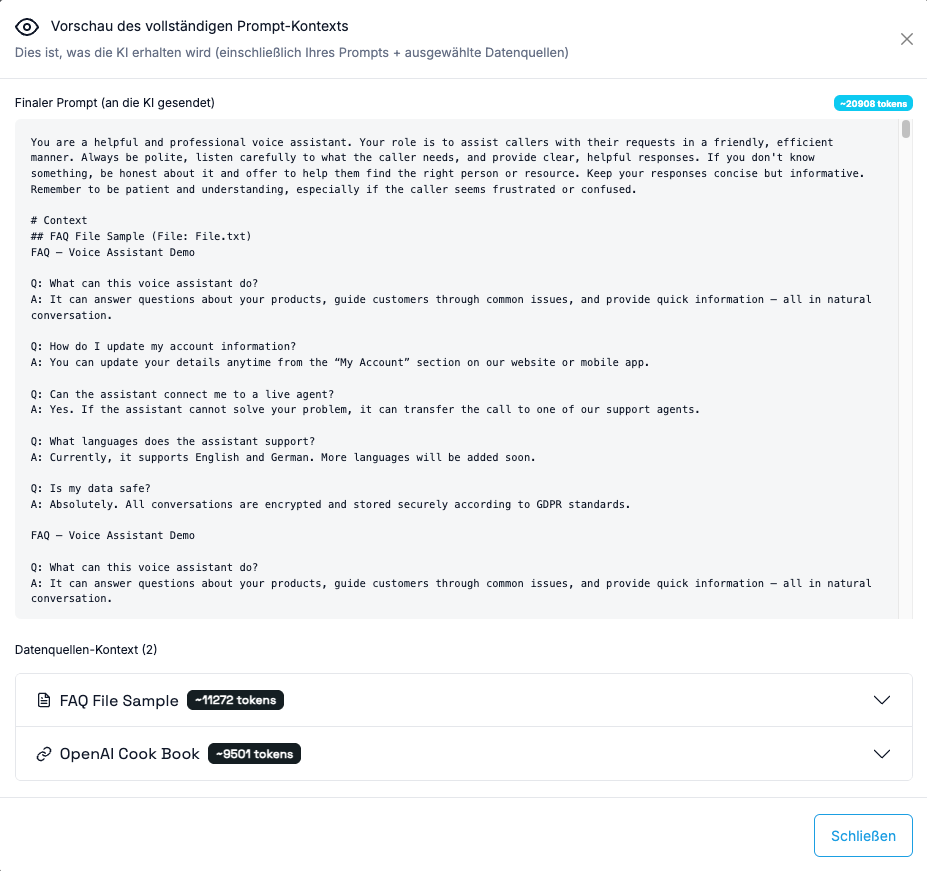
New feature: You can now display the complete prompt including all activated data sources. How it works:- In the Voice Wizard -> prompt section
- Click the “Preview” button
- A modal window shows the complete context that is sent to the AI
%%context:name%% syntax is not shown in the preview.
Important: Change to data source integration
Old (being discontinued):
New (recommended):
Use the Knowledge Base tab in the Voice Wizard with toggle-based activation.Timeline
Migration in 3 simple steps
1
Review your data sources
Go to Knowledge Base in the left navigation and review your existing data sources. If you previously used
%%context:faq%%, you should find a data source named “faq”.2
Clean up your prompt
Remove all After:
%%context:...%% placeholders from your prompt.Before:3
Activate data sources in the Wizard
Go to Voice Wizard -> Knowledge Base tab and activate the desired data sources with the toggle switch (on/off).
Benefits of the new method
Frequently asked questions
Why won't my large PDF file upload?
Why won't my large PDF file upload?
The upload is rejected if one of the following conditions is exceeded:
- File size: More than 15 MB
- Extracted text content: Too much text for a single data source (roughly more than 20-30 pages of text)
Can I use PDF documents with images?
Can I use PDF documents with images?
Yes, you can upload PDFs with images. The system automatically extracts the existing text from the PDF.Important to note:
- Only real text is extracted from the PDF (e.g. text created with a text editor)
- Text that is only embedded as an image in the PDF (e.g. scanned pages without OCR) cannot be read
- Images themselves are not processed — only the text is used
What happens if I activate too many data sources?
What happens if I activate too many data sources?
The agent receives a large amount of context at once, and response quality can degrade. The AI may struggle to find the most relevant information and answer precisely.Pay attention to the token warnings and consider whether all activated data sources are really necessary for the agent’s current task.
Where is my data stored?
Where is my data stored?
All uploaded data sources are stored centrally for your entire tenant (account) and are visible to all users in your account.The files and data are stored on servers in the EU and are subject to European data protection regulations (GDPR).
Where do I find my old %%context:...%% data sources?
Where do I find my old %%context:...%% data sources?
All existing data sources are still available in the Knowledge Base. They just need to be activated in the Voice Wizard via the toggle switch instead of being referenced in the prompt.
Can I see which data sources are currently active?
Can I see which data sources are currently active?
Yes, there are two ways:
- In the Voice Wizard -> Knowledge Base tab: All activated data sources have their toggle switch set to “ON”
- Prompt preview: Shows the complete context with all activated data sources, exactly as it is sent to the AI